|
|||
| Total Body Water Control
|
|||
There’s
more to life than just what’s going on in the cell. For a multicellular
organism (MCO), like the human body, what’s going on in the extracellular space
matters too. That’s because the intracellular (ICF) and extracellular fluid
(ECF), and their respective chemical contents, are very different, and this
difference must be maintained for survival.
As
previous articles have shown, if the forces of nature were allowed to work to
their natural ends, it would permanently alter the ICF and ECF and MCO life
would be impossible. To stay alive life must come up with innovations to combat
and/or use the forces of nature, and the laws that govern them, to its
advantage.
This
is a major lacuna in the evolutionary biology narrative. It usually fails to
even mention it. Instead, it conflates having explained the phylogenetics, structural
components and the necessity of a given innovation in different organisms, to having
explained its origin. In addition, it also leaves out any discussion of the
algorithmic processes the innovation must use to accomplish its function
properly and how it just happens to have the right functional capacity for survival.
In essence, evolutionary biology mainly talks about how life looks, but not how
it actually works.
How
Life Really Works!
The
interface between the ICF/ECF is the cell membrane. The second from last
article explained how about a million sodium-potassium pumps in the cell
membrane constantly combat diffusion and osmosis to maintain its proper volume
and chemical content.
Where
did the information come from to make the sodium-potassium pumps and how do they
know what they have to do to maintain the ICF:ECF ratio at 2/3:1/3? How did the
cell know how many sodium-potassium pumps to make and where to place them?
Evolutionary
biology’s simplistic answer is “They evolved”.
The
interface between the interstitial (ISF) and intravascular fluid (IVF) is the
capillary wall. The last article explained that to maintain enough blood
volume, there has to be enough albumin in the blood to have enough osmotic
pressure to bring enough water back into the circulation against the ultrafiltering
force of hydrostatic pressure.
How
did the body know it would need albumin for this task and from where did the
information come to tell the liver how to make it and how much so the blood has
enough osmotic pressure?
Evolutionary
biology’s simplistic answer is “It evolved”.
Even
though the sodium-potassium pumps in the cell membrane make sure the ICF:ECF
ratio is 2/3:1/3 and albumin in the blood makes sure the ISF: IVF ratio is
80:20, if there isn’t enough total body water (TBW) you’re dead.
Without
enough water in the ICF, the low volume and high chemical concentration makes the
cell’s metabolic processes malfunction, causing death. And without enough water
in the ECF, the significant drop in blood volume and blood pressure compromises
blood flow to the tissues, resulting in death. So, the TBW really does matter!
However,
being able to manage the TBW is a lot harder and more complicated than managing
the ratios of ICF:ECF and ISF: IVF. No matter what’s happening in the body, to
accomplish the latter two tasks the sodium-potassium pumps in the cell membrane,
and the albumin in the blood, just need to keep doing the same things at the
same rates.
But
trying to control the TBW is much more difficult because it is a dynamic
process.
Just
think about how your TBW is affected when you are outside working or playing
hard in humid and warm weather compared to just lying around relaxing in an air-conditioned
room.
Let’s
take a closer look!
Following
the Rules of MCO (Human) Life
Life
doesn’t happen within a vacuum nor the vivid imaginations of evolutionary
biologists. The reality is that living within the forces of nature, and the
laws that govern them, obligates the body to constantly lose water from the ECF
to its surroundings. Here are four reasons why.
1.
The
body must have enough energy to survive. Cellular respiration (the breakdown of
glucose in the presence of oxygen for energy) forms water as a by-product.
Every time you exhale you release water vapor into the air.
2.
The
body must maintain its temperature within a narrow range so its cellular enzymes
can work right. The more active the body, the more heat it produces, which must
be released to keep its temperature under control. One way is by perspiration—the
secretion of water onto the surface of the skin—which uses heat to evaporate
into the air.
3.
The
gastrointestinal system secretes water, with various chemicals in solution,
into its lumen to help it digest and absorb the nutrients the body needs.
Although it reabsorbs most of the water it sends out, some of it does get
released and is lost to the body.
4.
Protein metabolism produces ammonia which the liver converts into a
more soluble molecule called urea. The build-up of ammonia and urea in the body
can be toxic. The kidneys continuously filter water from the blood. This fluid
moves through millions of microtubules becoming more concentrated with urea as
it becomes urine. If none of this water could be reabsorbed the body would die
in 90 minutes.
Though
the body is constantly losing water from the ECF, it is able to compensate for
a while. The loss of water from the ECF increases its total chemical
concentration compared to the ICF. This makes water naturally move from the ICF
to the ECF by osmosis. Upon drinking water, it enters the ECF from the
gastrointestinal tract. The increase of water into the ECF reduces its total
chemical concentration compared to the ICF. This makes the water naturally move
from the ECF back into the ICF, by osmosis, to replenish the cells.
The
cells (ICF) act as a reservoir for the water needs of the ECF. But the limit to
how much water the body can lose before it dies is about 25%. Since normal TBW
is about 40 liters this means that a loss of about 10 liters of water results
in death. Moreover, since the minimum daily loss of water by the four mechanisms
mentioned above is about one liter, this explains why when someone is unable to
take in any water at all, they usually die in about 10 days.
The
Hard Problem
Since
the body is always losing water, it is always at risk of dying from
dehydration. Drinking water helps to prevent this from happening. But how much
water intake is right so it doesn’t cause other problems, like fluid overload
and altering the ECF’s total chemical concentration?
As
noted above and in previous articles, not having enough water can cause death
but so can having too much water as well. And depending on the body’s level of activity and
the ambient temperature and humidity, how long can the body go without taking
in water before it collapses?
All
of these are important practical questions for which the body must have
adequate answers.
And
in contrast to the sodium-potassium pumps and albumin, which function the same
(static), no matter what is going on in the body, this represents a dynamic problem
requiring a solution.
Here’s
how Steve Laufmann and I explained the situation in our book Your Designed Body.
“The
body must manage the right functional capacities, with exactly the right timing
(dynamics) for all its systems, such that they can support the entire range of
the body’s needs. The body must use thousands of different signals—chemical,
electrical, or both in combination—to coordinate and control all the systems.
Each signal must be triggered at the right time and place, sent over some
distance, then received and interpreted at another specific location to produce
a specific outcome. Controls must work within critical time constraints. The
time required to start and stop various systems, communications transmission,
speeds, capacity ramp up and response times and the proper “locality of effect”
are all critical to life.”
What
type of innovation do you think would be needed to solve this really hard
problem?
What
sorts of information would be needed to manage the ongoing TBW needs of the
body?
Take
a few minutes to think it through.
Hint:
consider how thirsty you get and the quantity and concentration of urine you
produce when you work or play hard in the heat and humidity without drinking
compared to other less stressful situations.
The
(Dynamic) Innovative Solution
The
kidney is the dynamic innovation that maintains the TBW. It also controls the
ECF’s sodium, potassium, calcium, magnesium, phosphate, hydrogen, chloride and
bicarbonate ion levels while ridding the body of urea and other toxic nitrogen
compounds.
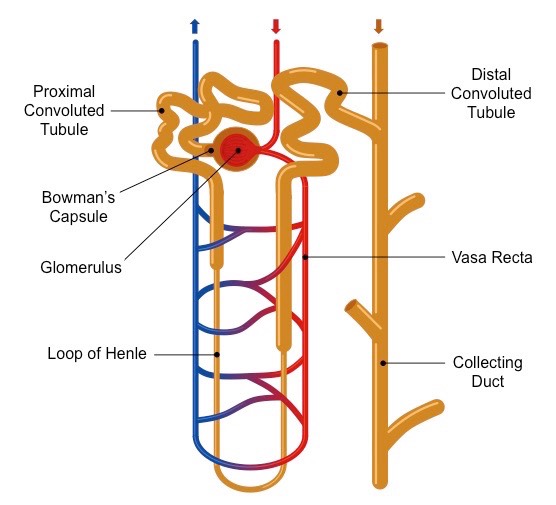
Each
kidney consists of about a million functional units called nephrons (see Fig.1) . The kidneys filter about 7.5 liters per hour (180 liters
per day) of fluid (with its chemical content) out of the blood. This fluid
enters microtubules which wind their way through the kidney tissue on its way
to becoming urine. As the fluid flows through the microtubules, the cells
lining them reabsorb water and other chemicals (and secrete others) to the
degree that is necessary for body survival.
Recall,
about 25% TBW loss (10 liters) results in death. About 90% of this filtered water
is automatically reabsorbed by the kidneys independent of the TBW content. But
this still leaves the other 18 liters per day. If none of that water were to be
reabsorbed death would take place in just over 12 hours.
How
do the kidneys “know” to hold onto more water when the TBW content is too low,
the same when the water it is normal and get rid of more when it is too high?
When
the TBW content drops and the ICF sends water, by osmosis, to shore up the ECF,
all the cells in the body shrink a little. There are nerve cells in the
hypothalamus, called osmoreceptors, that sense the amount of cell shrinkage and
so can sense the TBW content.
In
response to the degree of cell shrinkage, the osmoreceptors send out a specific
frequency of impulses that tells the posterior pituitary gland to send out a
specific amount of a hormone called Anti-Diuretic Hormone (ADH) (a diuretic
makes the kidneys send out water, so an anti-diuretic makes them hold onto
water).
ADH
travels in the blood and attaches to specific ADH receptors on the cells lining
specific microtubules in the kidneys. It tells them to bring back more water
into the body from the urine presently in production. ADH also signals the
thirst center in the hypothalamus telling the body to drink more water. Both of
these actions serve to raise the TBW content back to normal.
If
the TBW content is too high, less ADH is sent out causing more water to be
released from the urine while the thirst center is suppressed.
The
way the kidneys manage the TBW is an algorithmic process;
Decreased
water cells shrink increased release of ADH increased thirst, less urine
output
Increased
water cells bloat decreased release of ADH decreased thirst, more urine
output
Real
Numbers Have Real Consequences
Physicians
and engineers do their work within the real world where real numbers have real
consequences—even death! Here is how we expressed it in Your Designed Body.
“Physicians
don’t get to make stuff up. They don’t have the luxury to merely observe how
life looks or theorize about its superficial qualities. They need to know how
the body really works, how the parts affect each other, and what it takes in
practical terms to keep it all working over a (hopefully) long lifetime. Though
their mistakes sometimes take longer to discover than those of physicians,
engineers also must live in the real world. Engineers design, build, deploy,
and operate complex systems that do real work in the real world. And it takes
yet more work to keep the systems from failing.”
As
opposed to physicians and engineers, the concept of “functional capacity” seems
to be totally absent from the mindset of evolutionary biologists. That’s
because their theoretical constructs always lack the objective criteria needed
to verify that a given biological structure works well enough for survival—in
other words its functional capacity and the control mechanisms needed to
maintain it are good enough
Yet,
no matter how complex the genetics leading to a sophisticated biological
structure, if it can’t control and maintain the functional capacity to combat and/or
use the laws and forces of nature to its advantage, the organism in which it is
housed is as good as dead.
The
same applies to kidney function and TBW control.
As
a hospice physician, I know that having adequate kidney function is needed for
survival. As noted above, the kidneys control a lot of different chemicals in
the ECF. When the functional capacity of the kidneys is less than 20% the levels
of most of these chemicals can go outside the normal range, causing weakness,
fatigue, nausea and vomiting and shortness of breath death.
In
addition, because the kidneys aren’t working very well, they have problems
getting rid of excess fluid so the TBW tends to rise. This usually results in edema
of the tissues and a build-up of fluid in the lungs which makes breathing more
difficult, often causing debility and death.
When
it comes to human life, real numbers have real consequences!
“Evolutionary “Explanations”
Questions
Onward!
|