|
|
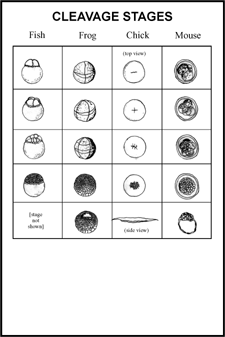
The diversity of the earliest stages of development, here illustrated strictly within the vertebrates, provides one of the strongest challenges to the neo-Darwinian conception of homology and macroevolution. Given the hierarchical, step-wise logic or "architecture" of animal development, early stages such as cleavage and gastrulation lay the groundwork for all that follows. Body plan structures in the adult, for example, trace their cellular lineage to these early stages. Thus, if macroevolution is going to occur, it must begin in early development. Yet it is precisely here, in early development, that organisms are least tolerant of mutations. Furthermore, the adult homologies shared by these vertebrates commence at remarkably different points (e.g., cleavage patterns). How then did these different starting points evolve from a common ancestor? |
| Figure 4. Cleavage, gastrulation and neurulation stages in fish, frog, chick, mouse (collated from various embryology texts). | |
Copyright © 1997 Jonathan Wells and Paul
Nelson. All rights reserved. International copyright secured.
File Date: 1.1.98