|
|
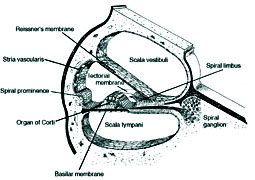
Figure 1. An example of functional complexity in a biological system. This is an enlarged, schematic cross-section through one turn of the mammalian cochlea, part of the inner ear. The cochlea is a spiraling, fluid-filled tunnel where fluid-borne mechanical signals, caused originally by air pressure against the tympanic membrane (i.e., "ear drum"), are converted into neural code carried by the auditory nerve to the brain (see J.B. Allen and S.T. Neely, "Micromechanical Models of the Cochlea," Physics Today, July 1992, pp. 40-47). Structures like the cochlea develop via "cascading interactions" of genes, thus manifesting, M.P. Schutzenberger argues, complexity far beyond the reach of neo-Darwinism. (Figure after A. Romer and S. Parsons, The Vertebrate Body [Philadelphia: W.B. Saunders, 1977], p. 487.) |
Copyright © 1996 Marcel-Paul Schützenberger.
All rights reserved. International copyright secured.
File Date: 11.19.96